



Bitcoin’s four-year cycle is back in the spotlight after Mags argued that the structure remains intact, placing the market in the 2026 bear-market phase and pointing to 2027 as the next major accumulation window if the historical rhythm holds.
The argument is simple and powerful because it matches how Bitcoin has traded for more than a decade. The 2011 to 2014 cycle produced a buy year, a hold year, a sell year and a bear market. The same broad rhythm appeared again from 2015 to 2018 and from 2019 to 2022. Under that map, 2023 was the buy year, 2024 was the hold year, 2025 was the sell year, and 2026 becomes the bear-market year before a possible 2027 accumulation phase. They history for past bull and bear runs shows us that many things can be possible for the crypto market.

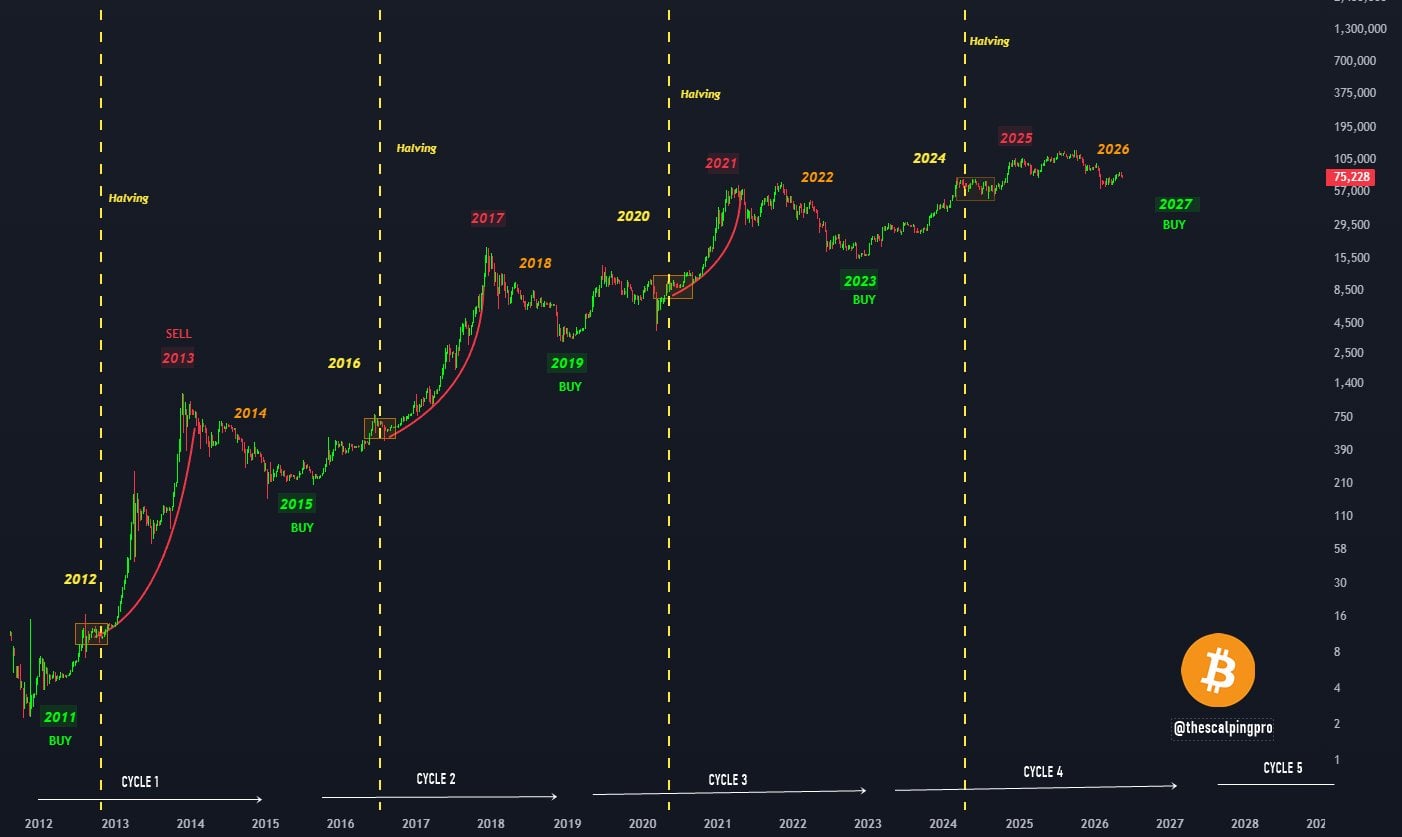
Bitcoin is currently trading near $75,700, far below the euphoric levels that dominated late-cycle discussions. That weakness gives the cycle argument more weight because the market no longer feels like a clean extension of the post-halving rally. It looks closer to the kind of cooling phase that has historically followed Bitcoin’s strongest upside years.
The cycle claim should not be treated as a calendar guarantee. It is a framework, not a law. Bitcoin’s market structure has changed dramatically since the early cycles, with spot ETFs, public-company treasuries, institutional custody, derivatives liquidity, sovereign-policy debate and tighter exchange compliance all playing larger roles. Still, the recurring rhythm has survived enough market changes to remain useful when price begins behaving like a late-cycle asset again.
Why The Four-Year Pattern Still Has Weight
Bitcoin’s supply schedule gives the four-year cycle its foundation. The network cuts miner rewards roughly every four years, and the most recent halving reduced the block subsidy from 6.25 BTC to 3.125 BTC at block 840,000 in April 2024. The next halving is expected around 2028, when the subsidy falls again to 1.5625 BTC.
That programmed supply shock does not automatically create a bull market. It reduces new issuance, but price still depends on demand, liquidity, leverage, macro conditions, miner balance sheets, exchange depth and investor psychology. The reason the cycle has mattered historically is that each halving has tended to change the supply-demand backdrop at the same time market attention, speculative flows and long-term accumulation narratives returned.
The current cycle followed enough of that path to make the 2027 call credible. Bitcoin recovered strongly from the 2022 bear-market low, rallied through 2023 and 2024, and carried post-halving momentum into the cycle’s later phase. The weakness now fits the part of the map where late buyers lose control, leveraged exposure unwinds, and long-term investors begin waiting for deeper value rather than chasing momentum.
The ETF era complicates the picture. U.S. spot Bitcoin ETFs created a new regulated demand channel, but they also made fund flows more visible and more important for day-to-day sentiment. Recent spot Bitcoin ETF outflows have already shown how quickly institutional demand can move from tailwind to pressure. In earlier cycles, retail mania and offshore leverage dominated the story. In this cycle, ETF inflows, redemptions, treasury activity and institutional portfolio decisions now sit beside the halving as major market drivers.
That is why the four-year cycle is still useful, but less complete than before. It explains the rhythm. It does not explain every flow.
The 2027 Buy Window Should Not Be Treated As Blind Accumulation
Calling 2027 a potential buy year makes sense only if investors treat it as a process, not a single date. Previous accumulation windows rewarded patience because Bitcoin spent long periods rebuilding after speculative excess had been flushed out. Bottoming structures usually take time. They involve failed rallies, lower volatility, reduced social attention, miner stress, weaker altcoin liquidity and long periods where the market feels boring rather than exciting.
A real accumulation window would likely need several signals to line up. Bitcoin would need to stop making aggressive lower lows, ETF outflows would need to stabilize or reverse, long-term holders would need to absorb supply, and leverage would need to reset without repeated liquidation cascades. Public-company treasury activity would also matter because corporate Bitcoin buyers have become a visible part of this cycle’s demand base.
Recent treasury stories show why that matters. Trump Media’s latest Bitcoin transfer raised questions because large coins moving toward exchange-linked infrastructure can affect market confidence even when a company says it transferred, but did not sell the assets. Those flows are different from retail panic selling, but they still shape how traders interpret balance-sheet risk when BTC weakens.
The same caution applies to prediction markets and short-term sentiment. A recent Polymarket Bitcoin setup placed higher odds on BTC reaching $70,000 before $90,000, reflecting near-term defensive pricing rather than a long-term cycle forecast. These shorter signals can push price around inside the larger cycle, especially when liquidity is thin and ETF demand is negative.
What Would Break The Cycle Argument
The strongest challenge to the four-year cycle is not that it has failed already. It is that Bitcoin’s ownership base has changed enough to stretch or distort the timing. ETFs can pull demand forward. Corporate treasuries can add balance-sheet reflexivity. Macro tightening can suppress risk assets even after supply cuts. Regulatory shocks can slow capital movement. Stablecoin liquidity, global dollar conditions and derivatives positioning can matter more than a simple halving calendar.
A clean break above prior highs during 2026 would weaken the bear-year argument. Sustained ETF inflows, stronger spot volume, lower exchange supply, improving macro liquidity and a return of institutional allocation could turn the current phase into a consolidation rather than a classic bear market. That would not fully kill the cycle, but it would make the 2027 accumulation call less clean because buyers would already have missed the easier discount.
The opposite path keeps the cycle intact. If Bitcoin loses the low-$70,000 area, spends months under pressure, and then stabilizes with lower volatility into 2027, the historical template becomes more convincing. In that version, 2027 would not need to be dramatic. It would simply become the year when long-term investors rebuild exposure while sentiment is still damaged and the next halving cycle is still distant enough to be ignored by casual buyers.
The four-year cycle is not dead just because Bitcoin has more institutional rails now. It is also not guaranteed just because the past lined up neatly. The useful read is practical: Bitcoin near $75,000, ETF flows under pressure, corporate treasury scrutiny rising, and traders still leaning defensive all support the idea that the market is late-cycle rather than early-cycle. If 2027 becomes the next major accumulation window, the best confirmation will not be a viral cycle chart. It will be months of price stabilization, cleaner fund flows, lower leverage, and renewed long-term demand before the next halving narrative fully returns.