


BitMart Research, the research arm of BitMart Exchange, has released a comprehensive report titled “Privacy Sector Shift: From Anonymous Tools to Financial Infrastructure”, offering a deep dive into how privacy technologies are evolving from fringe anonymity tools to foundational components of the crypto-financial system. As institutional players demand secure, compliant environments and regulatory frameworks around privacy assets begin to stabilize, the sector is witnessing a paradigm shift. From optional privacy layers and programmable compliance to advanced applications in AI and encrypted computation, the report charts how 2025 marked the structural recovery of privacy in crypto—not as a niche, but as an inevitability. With coverage of Zcash, Aztec, Nillion, Namada, and other next-gen protocols, the research highlights how privacy is becoming the new default layer for secure, scalable, and permission-aware on-chain activity.
I. The Privacy Sector: A Structural Recovery in 2025
Privacy has long been one of the most controversial and misunderstood areas in the crypto market. While blockchain transparency is often viewed as a core value, real demand for privacy has persisted and expanded across financial, commercial, and security use cases. By 2025, deeper institutional participation, clearer regulatory frameworks, and the maturation of zero-knowledge cryptography are driving the privacy sector away from adversarial anonymity toward more systematic, composable, and compliance-aware infrastructure. Privacy is increasingly becoming a fundamental component of crypto-financial systems rather than a peripheral feature.
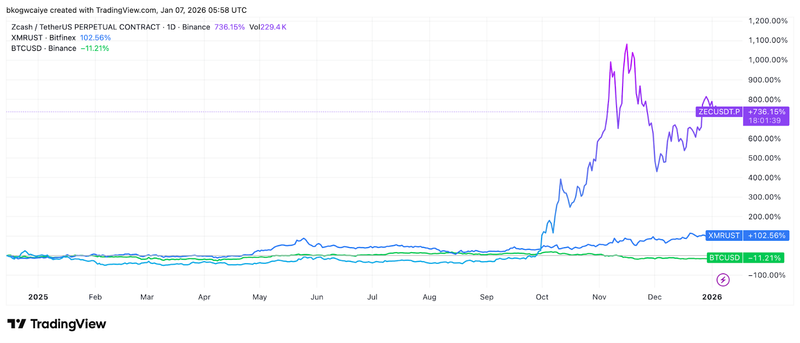
From a market perspective, the second half of 2025 has seen a clear recovery in privacy-related assets. Traditional privacy coins such as Zcash and Monero have outperformed the broader market. Zcash, in particular, saw gains of nearly 1,100% at its peak, briefly surpassing Monero in market capitalization. This rally reflects a re-pricing of optional privacy and regulatory flexibility, marking a shift from privacy assets as niche hedges to a broader reassessment of the long-term value of privacy infrastructure.
Technologically, the sector is undergoing a paradigm shift from Privacy 1.0 to Privacy 2.0. Early projects focused on transaction anonymity and reducing on-chain traceability, but offered limited functionality and compliance flexibility. The new generation of projects emphasizes computation and coordination over encrypted data, positioning privacy as a general-purpose infrastructure capability. Initiatives such as Aztec’s private smart contracts, Nillion’s blind computation network, and Namada’s cross-chain privacy solutions illustrate this transition from privacy as an asset attribute to privacy as a foundational infrastructure primitive.
II. Why Privacy Matters: Essential for Institutions and Complex Applications
Privacy is critical not because of ideology, but due to practical constraints. Over time, it also creates strong network effects: once users, assets, and applications gather on a privacy infrastructure, switching costs rise, giving protocols a potential “foundational moat.”
Institutional adoption requires privacy. In mature financial systems, asset allocations, trading strategies, and business relationships cannot be fully public. Full transparency may work in experiments, but at scale it becomes a barrier. Privacy enables “selective transparency,” balancing regulatory disclosure with business confidentiality.
On-chain transparency creates real security risks. As blockchain analytics improve, linking addresses to real identities becomes easier, increasing extortion, fraud, and personal threats. Financial privacy is no longer abstract—it’s a safety necessity.
AI and Web3 integration further raises privacy demands. Autonomous agents executing trades or strategies must verify compliance while protecting models, strategies, and user preferences. Simple address anonymity is insufficient; advanced tools like zero-knowledge proofs, MPC, and FHE are required.
III. Privacy Compliance: From Anonymity to Programmable Regulation
Privacy is now constrained by clear regulations rather than uncertain policy. For example, the EU’s AML rules ban financial institutions and crypto providers from handling “enhanced anonymity” assets—like mixers, ring signatures, and stealth addresses—that reduce traceability. The goal isn’t to reject blockchain, but to remove fully anonymous payments while enforcing KYC, transaction tracking, and travel rule compliance. With fines and licensing risks, centralized platforms can no longer support fully anonymous assets, changing privacy coins’ role in mainstream finance.
As a result, the privacy sector is moving from “fully anonymous coins” to “compliant privacy infrastructure.” Since 2025, mainstream projects have taken three approaches:
-
Optional Privacy: privacy features with compliance interfaces for institutions and exchanges.
-
Auditable Privacy: selective disclosure using zero-knowledge proofs or view keys.
-
Protocol-Level Compliance: embedding rules directly into protocols, proving compliance cryptographically rather than retroactively.
Regulators now distinguish between types of privacy, favoring compliant designs over fully anonymous tools. This evolution makes privacy infrastructure more reliable long-term and integrates it as a core part of a verifiable, next-generation financial system.
IV. High-Potential Privacy Projects (Simplified)
-
Zcash – Compliance Model
Zcash is a leading privacy project that uses optional privacy (t-address vs. z-address) instead of default anonymity. Its upgrades (e.g., Halo 2) reduce ZK proof costs, enabling mobile and institutional use. With wallets, payments, and compliance tools improving, Zcash is shifting from “anonymous coin” to “privacy settlement layer,” showing that privacy and compliance can coexist. -
Aztec Network – Ethereum Privacy Layer
Aztec uses ZK Rollups to enable private smart contracts on Ethereum, allowing programmable privacy. It supports private lending, trading, and DAO treasuries. Its value lies in potentially becoming Ethereum’s default privacy execution environment, critical for institutional DeFi. -
Railgun – Protocol-Level Privacy
Railgun adds privacy to existing assets via shielded pools, without moving assets to a new chain. It reduces migration costs, integrates with wallets and DeFi, and explores compliance-friendly features, offering privacy without fully anonymous design. -
Nillion / Zama – Privacy Computing Infrastructure
Nillion and Zama focus on privacy computing beyond blockchain. Nillion enables blind computation on encrypted data, while Zama uses fully homomorphic encryption. They target AI, enterprise data sharing, and RWA disclosure, acting as a Web3 “HTTPS layer” for broad applications. -
Arcium – Privacy for AI & Finance
Arcium is a decentralized privacy computing network combining MPC, FHE, and ZKP. It enables fully encrypted collaborative computation for AI and finance, including decentralized dark pools for large trades, merging privacy with real-world industries. -
Umbra – Privacy Payments for DeFi
Umbra provides a stealth address system on Ethereum and Solana, hiding transactions while allowing auditable privacy for compliance. Its SDK makes wallet and dApp integration easy, aiming to become the standard privacy payment layer in DeFi. -
MagicBlock – TEE-Based Privacy on Solana
MagicBlock uses TEE-based Ephemeral Rollups for low-latency, high-throughput privacy on Solana. It offers near-native performance without complex ZK proofs, making it easy to add privacy to DeFi or games. Its focus is practical usability, though it relies on hardware trust and faces future ZK competition.
V. 2026 Privacy Outlook: From Optional to Default
In 2026, the privacy sector is expected to grow steadily rather than through high-volatility hype.
Technically, ZK proofs, MPC, and FHE will become easier to use and more efficient. Privacy will be integrated into wallets, Layer 2s, and cross-chain systems as a default feature, not a separate add-on.Regulatory frameworks in major economies are stabilizing. As stablecoin and market structure rules take effect, institutional participation will rise, making compliant privacy infrastructure a prerequisite rather than a risk.At the application level, privacy will become “invisible.” Users may not notice it, but their assets, strategies, and identities will be protected by default. DeFi, AI agents, RWA settlements, and enterprise on-chain collaboration will all assume privacy as standard.
Long-term, the main challenge is not anonymity itself, but proving trust and compliance without exposing data—an essential step for crypto finance to reach maturity.
About BitMart
BitMart is a trusted global digital asset service provider with more than 13 million users worldwide. Consistently ranked among the top crypto exchanges on CoinGecko, BitMart offers over 1,700 trading pairs with competitive fees. Committed to continuous innovation and financial inclusivity, BitMart empowers users globally to trade seamlessly. Learn more about BitMart at Website, follow their X (Twitter), or join their Telegram for updates, news, and promotions. Download BitMart App to trade anytime, anywhere.
Risk Disclaimer:
The information provided above is for reference only and should not be considered as advice to buy, sell, or hold any financial assets. All information is offered in good faith; however, no representation or warranty—express or implied—is made regarding its accuracy, completeness, reliability, validity, or suitability.
All cryptocurrency investments, including wealth management products, are inherently highly speculative and carry a significant risk of loss. Past performance, hypothetical results, or simulated data do not guarantee future outcomes. The value of digital assets may rise or fall, and buying, holding, or trading them may involve substantial risk. Before engaging in any cryptocurrency transactions or holdings, you should carefully evaluate whether such investments are suitable for you based on your investment goals, financial situation, and risk tolerance. BitMart does not provide investment, legal, or tax advice.